I had a lovely post all done up only blogger had a moment and it got deleted..... : (
I was looking up information on the underground railroad and was going to tie it in with how some Jewish people were able to pass as some of the former slaves did. But in my research I came across this website that said that slavery was still going on today. While I was aware that in other countries like Africa this was a problem I did not know that it was still going on here in the US. So instead of posting that up now I'll save that for later and post something that may be kind of shocking if you thought that slavery was dead in our part of the world.
The information is all on this site: http://www.freedomcenter.org/slavery-today/
Has a lot of facts and tidbits about Slavery today. Also if you go to the main page it is a site that has information about the underground railroad.
Friday, May 16, 2008

Thursday, May 15, 2008
From the past to the present: Defiance
After a long while of trying to find something current to post on here I finally came across a movie trailer that I had seen a few months ago. It is for the film Defiance that will hit movie theaters in the fall.
Our class was based on two terms; Resistance(the act or power of resisting, opposing or withstanding) and Defiance (a daring or bold resistance to authority or any opposing force. In my eyes the most powerful, most effective and powerfuk
form of resistance in the holocaust was that of a physical nature. It was saving oneself or risking your life to save others. Strangers saving strangers, Gentiles saving Jews, passing and hiding. We know the stories of Le Chambon, Sophie Scholl and The White Rose and Oskar Schindler. I just wanted to bring the attention of another remarkable story of strength, hope, and as the title states: defiance.
It is the story of the Bielski brothers.
"In 1941, three brothers witnessed their parents and two other siblings being led away to their eventual murders. It was a grim scene that would, of course, be repeated endlessly throughout the war. Instead of running or giving in to despair, these brothers -- Tuvia, Zus, and Asael Bielski -- fought back, waging a guerrilla war of wits against the Nazis. By using their intimate knowledge of the dense forests surrounding the Belarusan towns of Novogrudek and Lida, the Bielskis evaded the Nazis and established a hidden base camp, then set about convincing other Jews to join their ranks. As more and more Jews arrived each day, a robust community began to emerge, a "Jerusalem in the woods." After two and a half years in the woods, in July 1944, the Bielskis learned that the Germans, overrun by the Red Army, were retreating back toward Berlin. More than one thousand Bielski Jews emerged -- alive -- on that final, triumphant exit from the woods."
Films like this not only depict the horrors and triumphs of the past, but also give us motivation to prevent that for the future. It's just a matter of reading in between the lines. We spoke at the end of the semester about passing our knowledge on from this class - I think a trip to the movies this fall and a discussion with your fellow viewers is a great way to do that!
Monday, May 12, 2008
Rescuer of Warsaw Ghetto Children Dies
 The death of a Polish woman who almost certainly saved the lives of 2,500 Jewish children during World War II has been announced.
Irena Sendlerowa organised the rescue of the children from the Warsaw Ghetto during the Nazi occupation.
She died in a Warsaw hospital at the age of 98, her daughter said.
After Germany's invasion of Poland in 1939, she took great risks to help Polish Jews held by the Nazis - an act that was punishable by death.Read the rest of the article from the BBC here.
Sunday, May 11, 2008
Holocaust
Often in education we focus on " Adult matters" , we put all of our thoughts and energy into conversations that very quickly rise over the heads of our youth. However it is those very children we speak over, those very children whom we tuck into bed with kisses, or who hand us fists full of dandilions , that we should be educating. We leave out of matters their futures will be be concerned with. The up and coming generations are those that we can mold and guide into being responsible /concerned citizens for future peace and justice.
I think it is important here to point out that the children of the holocaust did not have the choice, were not given the option to take part in a conversation that did very quickly rise over their heads. They were thrown into something so much larger and more complex than the innocence of a child can ever truly comprehend. Yet those that survived grew, and blossomed and reverted back to what they knew...education. It is in education that thoughts and truths cannot be taken away from you. It is one of the only things thing we will have forever.
I encourage you to view the following video and listen to the following song as you remember the children who perished in years past and say a prayer for all those who continue to perish as time goes by.
A PRAYER FOR CHILDREN
We pray for children who put chocolate fingers everywhere, who like to be tickled, who stomp in puddles and ruin their new pants, who sneak popsicles before supper, who erase holds in math workbooks, who never can find their shoes....
And we pray for those who stare at photographers from behind barbed wire, who can't bound down the street in a new pair of sneakers, who never "counted potatoes," who are born in places we wouldn't be caught dead, who never go to the circus, who live in an X-rated world.
We pray for children who bring us sticky kisses and fistfuls of dandelions, who sleep with the dog and bury goldfish, who hug us in a hurry and forget their lunch money, who cover themselves with Band-Aids and sing off key, who squeeze toothpaste all over the sink, who slurp their soup....
And we pray for those who never get dessert, who have no safe blanket to drag behind them, who watch their parents watch them die, who can't find any bread to steal, who don't have any rooms to clean up, who pictures are not on anyone's dresser, whose monsters are real...
We pray for children who spend all their allowance before Tuesday, who throw tantrums in the grocery store and pick their food, who like ghost stories, who shove dirty clothes under the bed and never rinse out the tub, who love visits from the tooth fairy, who don't like to be kissed in front of the school bus, who squirm in church or temple and scream in the phone....
And we pray for those whose nightmares come in the daytime, who will eat anything, who have never seen a dentist, who aren't spoiled by anybody, who go to bed hungry and cry themselves to sleep, who live and move and have no being.
We pray for children who want to be carried, for those who must, for those we never give up on, and those who will grab the hand of anyone kind enough to offer it.
by Rabbi Susan P. Fendrick
I think it is important here to point out that the children of the holocaust did not have the choice, were not given the option to take part in a conversation that did very quickly rise over their heads. They were thrown into something so much larger and more complex than the innocence of a child can ever truly comprehend. Yet those that survived grew, and blossomed and reverted back to what they knew...education. It is in education that thoughts and truths cannot be taken away from you. It is one of the only things thing we will have forever.
I encourage you to view the following video and listen to the following song as you remember the children who perished in years past and say a prayer for all those who continue to perish as time goes by.
A PRAYER FOR CHILDREN
We pray for children who put chocolate fingers everywhere, who like to be tickled, who stomp in puddles and ruin their new pants, who sneak popsicles before supper, who erase holds in math workbooks, who never can find their shoes....
And we pray for those who stare at photographers from behind barbed wire, who can't bound down the street in a new pair of sneakers, who never "counted potatoes," who are born in places we wouldn't be caught dead, who never go to the circus, who live in an X-rated world.
We pray for children who bring us sticky kisses and fistfuls of dandelions, who sleep with the dog and bury goldfish, who hug us in a hurry and forget their lunch money, who cover themselves with Band-Aids and sing off key, who squeeze toothpaste all over the sink, who slurp their soup....
And we pray for those who never get dessert, who have no safe blanket to drag behind them, who watch their parents watch them die, who can't find any bread to steal, who don't have any rooms to clean up, who pictures are not on anyone's dresser, whose monsters are real...
We pray for children who spend all their allowance before Tuesday, who throw tantrums in the grocery store and pick their food, who like ghost stories, who shove dirty clothes under the bed and never rinse out the tub, who love visits from the tooth fairy, who don't like to be kissed in front of the school bus, who squirm in church or temple and scream in the phone....
And we pray for those whose nightmares come in the daytime, who will eat anything, who have never seen a dentist, who aren't spoiled by anybody, who go to bed hungry and cry themselves to sleep, who live and move and have no being.
We pray for children who want to be carried, for those who must, for those we never give up on, and those who will grab the hand of anyone kind enough to offer it.
by Rabbi Susan P. Fendrick
Saturday, May 10, 2008
Do As I Say... Not As I Do
Obama discusses his views on the genocide in Darfur in this video, and after viewing it (and reading this article: http://seattlepi.nwsource.com/opinion/264131_olympics24.html ) it makes me question a few things. I have read a lot about the debates over whether or not the U.S. should boycott the Olympics (or the opening ceremonies) as a protest against China's policies with Darfur (among other reasons). Yet, I find it incredibly ironic that the United States is attempting to criticize another country for buying oil from a region that is participating in genocide. As it is doing so, it ALSO is buying oil from America's long-time best friend, Saudi Arabia, despite the ongoing tragic human rights issues that we hear about there, many of which specifically hurt women.
I think I spy a hypocrite! I say its time for America’s time-out. Perhaps some collective reflection on our flaws as a nation? A little therapy session for self-analysis, instead of always pointing the finger in another direction? We must break this habit of looking outside ourselves to find fault when we have so much work to accomplish internally.
More Hate Disguised as Denial
I cannot understand how Ahmadinejad tries to deny the Holocaust on the grounds that he likes to examine history and ask questions from a "scientific" approach. To say that the Holocaust has not happened, or to belittle the experiences of those who suffered during it, is certainly not scientific at all. When he says "Historical events are always subject to revisions," he is of course correct in stating that people have tried to rewrite history, many times. But to use this as an excuse for rewriting it or erasing it (because of one's own personal biases) is utterly wrong; and my heart breaks when thinking of those survivors who are alive today who have to listen to ignorant people like Ahmadinejad.
Thursday, May 8, 2008
An Act of Passive Resistance Gone Terribly Wrong

NORTH PROVIDENCE, R.I.--Approximately 250 people from across the region rallied here August 26 to protest the attack by North Providence police on a labor rights march that resulted in serious injuries to 22-year-old activist Alexandra Svoboda.
The rally was sponsored by the Industrial Workers of the World (IWW) and included members of several area unions and progressive organizations.
Police severely broke Svoboda's leg on August 11 when they moved in to forcibly arrest marchers during an IWW-sponsored picket of Jacky's Galaxy restaurant. Until recently, Jacky's Galaxy was supplied by the New York-based sweatshop HWH/Dragon Land Trading. Eyewitnesses confirm that the marchers were complying with instructions to move off the street when police charged without warning.
Svoboda has since undergone at least four surgeries for the injuries to her leg, and has yet to begin orthopedic reconstruction of her knee. Perversely, she also has been charged with assaulting the officers who broke her leg!
Police brutality and misconduct are a major problem in Rhode Island. Just four days before the attack on Svoboda, a Brazilian immigrant died in the custody of the Woonsocket police when he was denied his anti-seizure medication. The American Civil Liberties Union has exposed systematic racial profiling in several of the state's police departments.
The rally was sponsored by the Industrial Workers of the World (IWW) and included members of several area unions and progressive organizations.
Police severely broke Svoboda's leg on August 11 when they moved in to forcibly arrest marchers during an IWW-sponsored picket of Jacky's Galaxy restaurant. Until recently, Jacky's Galaxy was supplied by the New York-based sweatshop HWH/Dragon Land Trading. Eyewitnesses confirm that the marchers were complying with instructions to move off the street when police charged without warning.
Svoboda has since undergone at least four surgeries for the injuries to her leg, and has yet to begin orthopedic reconstruction of her knee. Perversely, she also has been charged with assaulting the officers who broke her leg!
Police brutality and misconduct are a major problem in Rhode Island. Just four days before the attack on Svoboda, a Brazilian immigrant died in the custody of the Woonsocket police when he was denied his anti-seizure medication. The American Civil Liberties Union has exposed systematic racial profiling in several of the state's police departments.
I was present at the beginning of this peaceful gathering. I saw the police officers watching; almost waiting eagerly to jump at something. We were all gathered, talking with one another, passively and non-violently showing our resistance to the issue at hand. I left before the brutality took place. I couldn't even believe it when I heard what had happened... What will come next?
"Just as despair can come to one only from other human beings, hope, too, can be given to one only by other human beings." -Elie Wiesel
"An injury to one is an injury to all" -IWW
Info provided by: http://socialistworker.org/2007-2/642/642_15_NewsAndReports.shtml
More photos available: http://jonathanmcintosh.smugmug.com/gallery/3293537_JGVms
More photos available: http://jonathanmcintosh.smugmug.com/gallery/3293537_JGVms
Nazi Scrapbooks from Hell
The National Geographic Channel recently aired program called "Nazi Scrapbooks from Hell", based upon a recently discovered notebook full of photographs of the Nazi party.. This notebook contains disturbing images of Nazis celebrating Christmas, having parties, picnics, etc - right in the middle of Auschwitz.
Here is a link to the National Geographic Website with photos.
http://channel.nationalgeographic.com/episode/diaries-from-hell-3675/Overview#tab-scrapbook-photos
Here is a link to the National Geographic Website with photos.
http://channel.nationalgeographic.com/episode/diaries-from-hell-3675/Overview#tab-scrapbook-photos
Wednesday, May 7, 2008
Japanese Temple Refuses to Host Olympic Torch
 Read this article from the AP (via msnbc) - April 18, 2008
This is another example of a violation of basic human rights. Tive is held captive by China and has been for centuries. The passing ot eh torch has created an opportunity for the Tibetan people to protest in a very public way. It has allowed us to become aware of their plight.
These are very critical issues and the Chinese must be held accountable. Again, what started out as peaceful has turned violent, because of lack of security another promise not kept.
For more information listen to this NPR story titled Monks' Protest Rejects Chinese Rule in Tibet.
--Priscilla Sturn
Do You Hear the People Sing
 This is one of my favorite plays. This music is from Les Miserables, which speaks about a revolution in France. Hopefully, we as people will always feel free to fight for what we think is right. When ever anyone tries to take our freedom away we will fight to retain it. Hopefully, we will fight for anyone who's freedom is threatened.
The lyrics follow:
Do you hear the people sing?
Singing a song of angry men?
It is the music of a people
Who will not be slaves again!
When the beating of your heart
Echoes the beating of the drums
There is a life about to start
When tomorrow comes!
Will you join in our crusade?
Who will be strong and stand with me?
Beyond the barricade
Is there a world you long to see?
Then join in the fight
That will give you the right to be free!
Do you hear the people sing?
Singing a song of angry men?
It is the music of a people
Who will not be slaves again!
When the beating of your heart
Echoes the beating of the drums
There is a life about to start
When tomorrow comes!
Will you give all you can give
So that our banner may advance
Some will fall and some will live
Will you stand up and take your chance?
The blood of the martyrs
Will water the meadows of France!
Do you hear the people sing?
Singing a song of angry men?
It is the music of a people
Who will not be slaves again!
When the beating of your heart
Echoes the beating of the drums
There is a life about to start
When tomorrow comes!
Click here to learn more about Les Miserables from the Wikipedia.
--Priscilla Sturn
Jane Fonda’s Hanoi Trip/Jimmy Carter’s Peace Mission

Jane Fonda was hated by pro-war patriots and veterans in 1972 when she went to what was then North Vietnam and sat at an anti aircraft gun emplacement in the capitol, Hanoi. She was loved by anti-war patriots, whose crowd was growing as Richard Nixon’s ‘round the clock, carpet bombing policies were stepping up in that third world country. But there was a dichotomy in her placement behind a gun, if she was there to represent peace. She was used by
Recently, former president, Jimmie Carter went to Palestine to discuss peace with representatives of the elected party, Hamas. Although his representation should carry a little more weight than a celebrity, like Fonda, (and he does in the political arena) the general population of the
Perhaps then, we should send Opra Winfry to speak to Al Quieda.
Click here For Carter’s interview with Charlie
Tuesday, May 6, 2008
The Lakota Tribe
Just like in the holocaust the American Indians have faced their own share of hardships that were pressed upon them by citizens the US. Since people started settling here in the 1500’s there has always been problems with the natives and the new comers but this incident that I will talk about is one of the more recent and pretty much last of it’s kind that has happened between the American Indians and the US government.
In the 1800's the earliest non-Indian people in the west were trappers and traders. They mostly got along with the Indians and shared resources and would also marry Indian women. As time moved forward settlers started going west and began building homes and putting fences up on the Indians land, pushing them out. As more people wanted to go west the military was sent in to remove the Indians from the land. They proposed treaties and made offers that they claimed the Indians would greatly benefit from in exchange for the land. Once treaties were created they were soon broken and new ones were made up.
The first treaty was in 1851. It allowed white settlers to travel through the Platte River Valley and boundaries were set up for the Lakota tribe. Another treaty was drawn up in 1868 was an agreement between the United States and the Lakota nation, guaranteeing to the Lakota ownership of the Black Hills, and further land and hunting rights in South Dakota, Wyoming, and Montana. The Powder River Country was to be closed to all others. This treaty ended the war between Red Cloud and the US government. In the Agreement of 1876 the US government triggered another war because they wanted the Indians to give up the Powder River hunting grounds. At that same time gold was discovered in the Black Hills and miners came from all over to retrieve it. This broke the treaty of 1868. The US response was to annex the Black Hills. This gave the Indians less territory.
The Dawes act of 1887 was another negotiation that shrank the tribal lands into smaller reservations where each family would get a small parcel of land to tend. There were seven reservations; Cheyenne River Agency, Crow Creek Agency, Lower Brule Agency, Rosebud Agency, Sisseton Agency, Yankton Agency and Pine Ridge Agency. Americans would be appointed to go to these agencies and appoint land to the Indian families and would be in charge of passing out supplies and maintaining order among the people.
The American Indians once in and starting to settle would try their best to adapt and continue with their way of life. Ghost dancing was part of it. It is a spiritual dance that was done as a way of communicating with the deceased in hopes that they may return in some form. In 1888 a man named Wovoka reported that the Great Spirit had spoken to him in a vision, asking him to take the message to all Indian tribes that performing the Ghost Dance would bring about a renewal of the earth, the return of the buffalo, and their deceased loved ones would live again. Wovoka preached peace, saying that God asked Indians not to fight each other or the white man. Tribal leaders met with him and took the message home. All of the tribes adopted Wovoka's advice against violence except for the Sioux. They were still quite angry over the broken land treaty in February of 1890 and the reduction in rations. Although Ghost Dancing was a spiritual ceremony, some agents for other tribes misinterpreted it as a war dance. The agents became frightened and sent for military help to stop what they interpreted as upcoming war.
On December 15, Chief Sitting Bull was killed at his cabin on the Standing Rock Reservation by Indian police who were trying to arrest him on government orders. Sitting Bull was one of the Lakota’s tribal leaders, and after his death, refugees from Sitting Bull’s tribe fled in fear. They joined Sitting Bull's half brother, Big Foot, at a reservation at Cheyenne River. Unaware that Big Foot had renounced the Ghost Dance, General Nelson A. Miles ordered him to move his people to a nearby fort.
On December 28, Big Foot became seriously ill with pneumonia. The tribe then set off to seek shelter with Red Cloud at Pine Ridge. Big Foot’s group was intercepted by Major Samuel Whitside and the Seventh Cavalry Regiment and was escorted five miles westward to Wounded Knee Creek. There, Colonel James W. Forsyth arrived to take command and ordered his guards to place four Hotchkiss guns in position around the camp. The soldiers, around 500; the Indians, 350. A rumor among the Lakota during the evening of the 28th, said that all Indians were to be deported to an Oklahoma territory, which had the reputation for living conditions far worse than any prison. The Lakota became fearful that the rumor was true.
On December 29, Lakota Ghost Dancers were on their way through the badlands toward Pine Ridge Indian Reservation. There the 7th Cavalry Regiment intercepted the dancers and ordered them to hand over their weapons. A search was ordered, and some of the weapons were collected. A shot was fired, prompting a call for the Cavalry to fire. At first, the struggle was fought at close range, but the fight moved as the Lakota sought to escape fire from the troops, who chased them for miles across the prairies. By the end of fighting, which lasted less than an hour, at least 150 Lakota had been killed and 50 wounded. In comparison, army casualties numbered 25 dead and 39 wounded. The military hired civilians to bury the dead Lakota after an intervening snowstorm had abated. Arriving at the battleground, the burial party found the deceased frozen in contorted positions by the freezing weather. They were gathered up and placed in a common grave. It was reported that four infants were found still alive, wrapped in their deceased mothers' shawls. In all, 84 men, 44 women, and 18 children reportedly died on the field, while at least seven of Lakota were mortally wounded.
After the battle Colonel Forsyth was immediately denounced by General Nelson Miles and relieved of command. An exhaustive Army Court of Inquiry convened by Miles criticized Forsyth for his tactical dispositions but otherwise exonerated him of responsibility. The Court of Inquiry, however, was not conducted as a formal court-martial, and without the legal boundaries of that format, several of the witnesses minimized their comments and statements to protect themselves or peers. Ultimately the Secretary of War concurred and reinstated Forsyth to command of the 7th. Testimony before the court indicated that for the most part troops attempted to avoid non-combatant casualties. Nevertheless Miles ignored the results of the Court of Inquiry and continued to criticize Forsyth, whom he believed had deliberately disobeyed orders. The concept of Wounded Knee as a deliberate massacre rather than a tragedy caused by poor decisions stems from Miles.
This incident is only one of many that go along with the American Indians. I’m not saying that it is right but as Americans, I think too much is concentrated on what bad things have happened outside our country and not enough is known about what happened here. Actually I think that not enough is even covered about what goes on in the world outside the US either. But a lot of people have at least heard about the holocaust and could tell you who was involved. How many can tell you about incidents that happened here on our soil? We really need to start from inside our own country and work our way out. It’s important to see the mistakes and the events of the people before us so we can be educated to not let something like that happen again. I think once people can get a grasp on that, then moving beyond our borders to learn about the history of another country would be a lot better.
You can find more information here: http://www.woundedkneemuseum.org/main_menu.html
Also there is a great film that HBO did last May called "Bury My Heart at Wounded Knee"
In the 1800's the earliest non-Indian people in the west were trappers and traders. They mostly got along with the Indians and shared resources and would also marry Indian women. As time moved forward settlers started going west and began building homes and putting fences up on the Indians land, pushing them out. As more people wanted to go west the military was sent in to remove the Indians from the land. They proposed treaties and made offers that they claimed the Indians would greatly benefit from in exchange for the land. Once treaties were created they were soon broken and new ones were made up.
The first treaty was in 1851. It allowed white settlers to travel through the Platte River Valley and boundaries were set up for the Lakota tribe. Another treaty was drawn up in 1868 was an agreement between the United States and the Lakota nation, guaranteeing to the Lakota ownership of the Black Hills, and further land and hunting rights in South Dakota, Wyoming, and Montana. The Powder River Country was to be closed to all others. This treaty ended the war between Red Cloud and the US government. In the Agreement of 1876 the US government triggered another war because they wanted the Indians to give up the Powder River hunting grounds. At that same time gold was discovered in the Black Hills and miners came from all over to retrieve it. This broke the treaty of 1868. The US response was to annex the Black Hills. This gave the Indians less territory.
The Dawes act of 1887 was another negotiation that shrank the tribal lands into smaller reservations where each family would get a small parcel of land to tend. There were seven reservations; Cheyenne River Agency, Crow Creek Agency, Lower Brule Agency, Rosebud Agency, Sisseton Agency, Yankton Agency and Pine Ridge Agency. Americans would be appointed to go to these agencies and appoint land to the Indian families and would be in charge of passing out supplies and maintaining order among the people.
The American Indians once in and starting to settle would try their best to adapt and continue with their way of life. Ghost dancing was part of it. It is a spiritual dance that was done as a way of communicating with the deceased in hopes that they may return in some form. In 1888 a man named Wovoka reported that the Great Spirit had spoken to him in a vision, asking him to take the message to all Indian tribes that performing the Ghost Dance would bring about a renewal of the earth, the return of the buffalo, and their deceased loved ones would live again. Wovoka preached peace, saying that God asked Indians not to fight each other or the white man. Tribal leaders met with him and took the message home. All of the tribes adopted Wovoka's advice against violence except for the Sioux. They were still quite angry over the broken land treaty in February of 1890 and the reduction in rations. Although Ghost Dancing was a spiritual ceremony, some agents for other tribes misinterpreted it as a war dance. The agents became frightened and sent for military help to stop what they interpreted as upcoming war.
On December 15, Chief Sitting Bull was killed at his cabin on the Standing Rock Reservation by Indian police who were trying to arrest him on government orders. Sitting Bull was one of the Lakota’s tribal leaders, and after his death, refugees from Sitting Bull’s tribe fled in fear. They joined Sitting Bull's half brother, Big Foot, at a reservation at Cheyenne River. Unaware that Big Foot had renounced the Ghost Dance, General Nelson A. Miles ordered him to move his people to a nearby fort.
On December 28, Big Foot became seriously ill with pneumonia. The tribe then set off to seek shelter with Red Cloud at Pine Ridge. Big Foot’s group was intercepted by Major Samuel Whitside and the Seventh Cavalry Regiment and was escorted five miles westward to Wounded Knee Creek. There, Colonel James W. Forsyth arrived to take command and ordered his guards to place four Hotchkiss guns in position around the camp. The soldiers, around 500; the Indians, 350. A rumor among the Lakota during the evening of the 28th, said that all Indians were to be deported to an Oklahoma territory, which had the reputation for living conditions far worse than any prison. The Lakota became fearful that the rumor was true.
On December 29, Lakota Ghost Dancers were on their way through the badlands toward Pine Ridge Indian Reservation. There the 7th Cavalry Regiment intercepted the dancers and ordered them to hand over their weapons. A search was ordered, and some of the weapons were collected. A shot was fired, prompting a call for the Cavalry to fire. At first, the struggle was fought at close range, but the fight moved as the Lakota sought to escape fire from the troops, who chased them for miles across the prairies. By the end of fighting, which lasted less than an hour, at least 150 Lakota had been killed and 50 wounded. In comparison, army casualties numbered 25 dead and 39 wounded. The military hired civilians to bury the dead Lakota after an intervening snowstorm had abated. Arriving at the battleground, the burial party found the deceased frozen in contorted positions by the freezing weather. They were gathered up and placed in a common grave. It was reported that four infants were found still alive, wrapped in their deceased mothers' shawls. In all, 84 men, 44 women, and 18 children reportedly died on the field, while at least seven of Lakota were mortally wounded.
After the battle Colonel Forsyth was immediately denounced by General Nelson Miles and relieved of command. An exhaustive Army Court of Inquiry convened by Miles criticized Forsyth for his tactical dispositions but otherwise exonerated him of responsibility. The Court of Inquiry, however, was not conducted as a formal court-martial, and without the legal boundaries of that format, several of the witnesses minimized their comments and statements to protect themselves or peers. Ultimately the Secretary of War concurred and reinstated Forsyth to command of the 7th. Testimony before the court indicated that for the most part troops attempted to avoid non-combatant casualties. Nevertheless Miles ignored the results of the Court of Inquiry and continued to criticize Forsyth, whom he believed had deliberately disobeyed orders. The concept of Wounded Knee as a deliberate massacre rather than a tragedy caused by poor decisions stems from Miles.
This incident is only one of many that go along with the American Indians. I’m not saying that it is right but as Americans, I think too much is concentrated on what bad things have happened outside our country and not enough is known about what happened here. Actually I think that not enough is even covered about what goes on in the world outside the US either. But a lot of people have at least heard about the holocaust and could tell you who was involved. How many can tell you about incidents that happened here on our soil? We really need to start from inside our own country and work our way out. It’s important to see the mistakes and the events of the people before us so we can be educated to not let something like that happen again. I think once people can get a grasp on that, then moving beyond our borders to learn about the history of another country would be a lot better.
You can find more information here: http://www.woundedkneemuseum.org/main_menu.html
Also there is a great film that HBO did last May called "Bury My Heart at Wounded Knee"
Saturday, May 3, 2008
Terror in the Name of God

During our discussion last class, one of the things that we touched on was the idea that we want (or maybe expect is a better word) the perpetrators to be genuinely bad people. When we see things like the video of Hitler at his hideaway, not in uniform, seeming like a normal person, it is deeply disturbing.
This reminded me very much of a book I read for an Anthropology course, titled "Terror in the Name of God: Why Religious Militants Kill," by Jessica Stern. One of the topics that Stern addresses in her book is the same issue that we discussed, namely that people expect terrorists to be bad people. However, these same people who blow up buildings and attack noncombatants also "profess strong moral values," and these "ordinary people can commit seemingly demonic acts." Most of the terrorists she interviews are family men, devout to their religion, giving to those who are in their circle.
Stern has some answers, but many of her answers point to twisting of religious dogma, which is difficult to tie to the Nazis. She does talk about an idea of doubling, where a person has two selves. Stern quotes a psychiatrist who has studied Nazis, Robert J. Lifton, who says "cult members become two people: the self they were, and the new, morally disengaged killer self." It becomes easier to see the ties here. She goes on to talk about "extinguishing the recruit's ability to empathize with his victim," which we have seen when studying the Holocaust.
This book is a very interesting one, and I recommend it. I'm sure there are many more ties, but this is what comes freshly to mind to share.
------------------------------------------------------------
Here is an interview with Jessica Stern, the author, with an excerpt from the book.
Friday, May 2, 2008
fixed link to Washington Post Obituary:
http://www.washingtonpost.com/wp-dyn/content/article/2005/09/20/AR2005092000201.html
http://www.washingtonpost.com/wp-dyn/content/article/2005/09/20/AR2005092000201.html
The Last Nazi Hunter

We briefly mentioned Simon Wiesenthal, the man famous for tracking down Nazis and bringing them to justice, in class. I wanted to know more about him and what drove him to carry out this mission. Was he seeking to rid the world of evil or did he want revenge for what him and his family had to endure during the Holocaust. What does his life's work say about the possibility of forgiveness or the ability to forget? I haven't yet come to many answers for these myself but, I do think if there were more men like Simon alive today, then Holocaust deniers would have a much more difficult job of convincing the world the Holocaust didn't happen. The link is to his obituary from the Washington Post.

"You can forgive crimes committed against you personally, but in my opinion you are not authorized to forgive for others" - Simon Wiesenthal
http://www.washingtonpost.com/wp-dyn/content/article/2005/09/20/AR2005092000201.html

Thursday, May 1, 2008
Curfew Quiets Central Falls
When looking for current news that reflected some of the elements or characteristics of the holocaust I was floored when the perfect example came out at me from the front page of Providence's local newspaper! The Providence Journal on May 1, 2008 headlined with "Curfew Quiets Central Falls." In reaction to several shootings that took place over the weekend, the city has now placed a curfew on individuals under the age of 18, forbidding them to be on the streets after 9pm. I couldn't help but think...if Central Falls can place a city-wide curfew on minors (under the umbrella of "for their own good")--what will they be able to do next? Check out the link below!
Curfew Quiets Central Falls - ProJo, May 1, 2008
Elena Jarret
Curfew Quiets Central Falls - ProJo, May 1, 2008
Elena Jarret
Defying Holocaust Deniers
I have always been intrigued by the pitiful people that deny that the holocaust ever happened...Holocaust Deniers- there's even and official name for them! Reading up on these people, it has come to my attention that they must spend allot of energy trying to ignore the blatant evidence that proves them wrong. When looking for more information on these outrageous people, I came across this video that was created to offer truth and proof to even the most narrow-minded individuals.
This video is an audio recording (held at the National Archives in College Park, MD) of Reichsfuhrer Heinrich Himmler speaking to SS officers in a secret meeting on October 4, 1943 in Poznan, Poland. His chilling words and nonchalant references to the millions of Jews being slaughtered at the hands of his men offers a sad but undeniable proof to the horrors of the Holocaust. It's somewhat difficult to watch. It will certainly boil your blood and chill your heart, but it's something that must be watched. Check it out at the link below....take that Deniers!
Elena Jarret
This video is an audio recording (held at the National Archives in College Park, MD) of Reichsfuhrer Heinrich Himmler speaking to SS officers in a secret meeting on October 4, 1943 in Poznan, Poland. His chilling words and nonchalant references to the millions of Jews being slaughtered at the hands of his men offers a sad but undeniable proof to the horrors of the Holocaust. It's somewhat difficult to watch. It will certainly boil your blood and chill your heart, but it's something that must be watched. Check it out at the link below....take that Deniers!
Elena Jarret
Ukranian Genocide
Below is the link for the second half of the article "Ukranian Genocide" by Projo columnist David Mittell. Mittell's arguments for "execution through starvation lead credence to the claim that Stalin's brutality rivaled Hitler's. Perhaps the most cruel irony of the piece is the fact that food was plentiful during the forced famine.
David A. Mittell: Genocide? You decide, Part II | Columnists | Rhode Island news | projo.com | The Providence Journal | Breaking news
David A. Mittell: Genocide? You decide, Part II | Columnists | Rhode Island news | projo.com | The Providence Journal | Breaking news
What's Next?
 First - your blog entries are really amazing. They are both thoughtful and interesting. They not only show a depth of knowledge and engagement, they offer all of us another perspective on various topics. Thank you.
With the idea of increased awareness not only of history but of the present ... I've complied a list of websites on various topics of interest that you may want to visit and become involved with.
This list certainly isn't exhaustive - feel free to add sites as extra blog entries.
Taking it Global HIV/Aids
Change.org
YouThink: Gender
Darfur Scores.org
World Changing
Don't forget about the many other organizations that have been doing great work for decades .... Amnesty International, GreenPeace, Doctors without Borders, Oxfam and many others ...
Government tracking of medication- a violation of privacy?
My post today comes from the Daily Women's Health Policy website. Daily Women's Health Policy sends regular (well, daily..haha) updates on various topics that are of interest to women, in regards to health, reproductive choice, harmful legislation, etc.
An email I received this morning stated that in the Missouri Senate on Tuesday, a statewide electronic drug monitoring system was voted on. This monitoring system would include certain controlled substances and some over-the-counter items. Clearly, the monitoring of legal/safe medications is something that would affect and invade the privacy of both men and women. If you have tried to purchase allergy or cold medication that includes the ingredient pseudophedrine in RI over the past few years, you have been asked to show ID and sign a document.
However, to put another (temporary) nail in the coffin of reproductive choice, the Senate "accidentally" allowed the tracking of Mifeprestone, known as the abortion drug. Please note that this pill is NOT the same pill as the morning-after pill, known as Plan B. Mifeprestone is also known as Ru-486 and has been legal in Europe for many years. The government does not currently have access to personal medical records without a subpoena. Most cases where anti-choice groups (Operation Rescue, etc) have tried to access these records have been overturned or denied by state Supreme Courts.
The inclusion of this drug would place it in the same "restricted" category as marijuana and heroin. Allegedly, Mifeprestone was included in this bill as what was referred to as a clerical error. After the bill was voted upon, Republican Senator Norma Champion noticed Mifeprestone on the list and called it to the Senate's attention, requesting another vote with Mifeprestone excluded. Senator Champion has declared that although she is not a proponent of abortion rights, she did not want to appear as being dishonest or having snuck Mifeprestone onto the list of restricted medication. RU-486 has been opposed since its inception, although it is safe, legal, and FDA approved.
I am curious to find out what the rest of the class thinks about this - how do you feel about the fact that it may become possible for the government to have this sort of access to your health care information? I am not looking to debate abortion politics (its the end of the semester and I'm tired) - just curious to see what people think about the possibility of the government voting to track your medication choices/needs.
I personally am questioning how a drug such as that one found its way onto a list of that type to begin with. If you have any frame of reference or experience with the reproductive choice agenda, it is extremely hard to believe that its inclusion was a mistake. Although Sen Champion came clean quickly after the vote, I wonder if she realized what a can of worms she would open if she neglected to do so...
While this post is not about the Holocaust, I found it relevant because it involves a tracking of personal information by the government, which I see as a serious invasion of privacy. If measures such as this one is approved, what is next?
The link to this specific article can be found below.
http://npwf.convio.net/site/News2?abbr=daily2_&page=NewsArticle&id=11169&security=1201&news_iv_ctrl=-1
-Robin
An email I received this morning stated that in the Missouri Senate on Tuesday, a statewide electronic drug monitoring system was voted on. This monitoring system would include certain controlled substances and some over-the-counter items. Clearly, the monitoring of legal/safe medications is something that would affect and invade the privacy of both men and women. If you have tried to purchase allergy or cold medication that includes the ingredient pseudophedrine in RI over the past few years, you have been asked to show ID and sign a document.
However, to put another (temporary) nail in the coffin of reproductive choice, the Senate "accidentally" allowed the tracking of Mifeprestone, known as the abortion drug. Please note that this pill is NOT the same pill as the morning-after pill, known as Plan B. Mifeprestone is also known as Ru-486 and has been legal in Europe for many years. The government does not currently have access to personal medical records without a subpoena. Most cases where anti-choice groups (Operation Rescue, etc) have tried to access these records have been overturned or denied by state Supreme Courts.
The inclusion of this drug would place it in the same "restricted" category as marijuana and heroin. Allegedly, Mifeprestone was included in this bill as what was referred to as a clerical error. After the bill was voted upon, Republican Senator Norma Champion noticed Mifeprestone on the list and called it to the Senate's attention, requesting another vote with Mifeprestone excluded. Senator Champion has declared that although she is not a proponent of abortion rights, she did not want to appear as being dishonest or having snuck Mifeprestone onto the list of restricted medication. RU-486 has been opposed since its inception, although it is safe, legal, and FDA approved.
I am curious to find out what the rest of the class thinks about this - how do you feel about the fact that it may become possible for the government to have this sort of access to your health care information? I am not looking to debate abortion politics (its the end of the semester and I'm tired) - just curious to see what people think about the possibility of the government voting to track your medication choices/needs.
I personally am questioning how a drug such as that one found its way onto a list of that type to begin with. If you have any frame of reference or experience with the reproductive choice agenda, it is extremely hard to believe that its inclusion was a mistake. Although Sen Champion came clean quickly after the vote, I wonder if she realized what a can of worms she would open if she neglected to do so...
While this post is not about the Holocaust, I found it relevant because it involves a tracking of personal information by the government, which I see as a serious invasion of privacy. If measures such as this one is approved, what is next?
The link to this specific article can be found below.
http://npwf.convio.net/site/News2?abbr=daily2_&page=NewsArticle&id=11169&security=1201&news_iv_ctrl=-1
-Robin
Holocaust Denial & the Big Lie
There are actually people who deny the Holocaust ever happened. Documented film, pictures, and written accounts do not play into what these people believe.
"Holocaust denial often involves the same assertions, repeated endlessly, regardless of response"."This document provides a counterpoint to assertions commonly made by those who deny that anyone was gassed at the Auschwitz-Birkenau and other death camps during World War II; who, in fact, deny that the gas chambers even existed".
This article was a great read because you wouldn't believe what reasons people give for the fact that the Holocause just couldn't have happened. One claim that stood out was "Why would there be a swimming pool at a death camp...?" There was a water hole that was converted into a swimming pool for the SS personnel at Auschwitz. Many claims spoke about the gas chambers, the type of gas used (Zyklon-B), and a reference to the gas chamber doors.
This article is based on the "Leuchter Report". Fred Leuchter is a History graduate who lied saying he had formal training in Chemistry or Toxology. In 1988 he was sent to Auschwitz to examine the remains and give a formal report. While Leuchter was under oath he failed to demonstrate any concern for the truth. The resistence comes from the people who prosecuted this man and exposed him for the fraud he really was. Stephanie Skymba http://www.healersvoice.com/History.root.rev.html
"Holocaust denial often involves the same assertions, repeated endlessly, regardless of response"."This document provides a counterpoint to assertions commonly made by those who deny that anyone was gassed at the Auschwitz-Birkenau and other death camps during World War II; who, in fact, deny that the gas chambers even existed".
This article was a great read because you wouldn't believe what reasons people give for the fact that the Holocause just couldn't have happened. One claim that stood out was "Why would there be a swimming pool at a death camp...?" There was a water hole that was converted into a swimming pool for the SS personnel at Auschwitz. Many claims spoke about the gas chambers, the type of gas used (Zyklon-B), and a reference to the gas chamber doors.
This article is based on the "Leuchter Report". Fred Leuchter is a History graduate who lied saying he had formal training in Chemistry or Toxology. In 1988 he was sent to Auschwitz to examine the remains and give a formal report. While Leuchter was under oath he failed to demonstrate any concern for the truth. The resistence comes from the people who prosecuted this man and exposed him for the fraud he really was. Stephanie Skymba http://www.healersvoice.com/History.root.rev.html
Displaced Persons
This video clip, from NTVKenya, focuses on the plight of internally displaced people in Kenya. These people have largely been displaced due to conflicts, and often consist of families and/or farmers.
A good portion of this clip focuses on one of the men in the camp who has AIDS, and has been unable to consistently recieve the nutrition and medicine that he should due to his disease. Unfortunately for us, his interview is not in English, so it is difficult to understand what he is saying. It is clear, however, that he is suffering, and people all around him are as well.
Another focus of this clip is about government donations of seed to displaced persons to help them start farming again, but it seems disturbingly like a photo opportunity (or even propaganda).
Estimates of displaced people in Kenya put numbers somewhere between 300,000-350,000 total, with many able to find homes (whether their old homes or new ones). One website puts the estimate of currently displaced Kenyans at 50,000-100,000.
This second video talks more about the desires of the Kenyans in displaced persons camps. Some of them want to return to their homes and farms, others want to be given different land to settle in. It seems that the government is happy to let those who want to return do so, but it's more questionable as to whether any will be provided with new land if that is what they want. There are also questions about what land would be used for displaced persons and where the money would come from, if things turn that way.
I found this second video to be somewhat more dry than the first, since it focuses much more on the government, with soundbites of a number of officials. The first seems to focus much more on the people, with no fancy graphics, and less time spent on politicians.
It is hard to watch these types of videos, because it brings vividly to mind the displaced persons camps after World War II. This seems to be yet another reminder of history repeating itself. It does seem that governments are putting forth some effort to solve the problems of the people in the camps, but in the meantime, people like the man in the first clip are dying of disease, and have been pushed out of their homes.
Statistics found at http://www.internal-displacement.org/countries/kenya
Wednesday, April 30, 2008
Hermann Graebe - Resistance After the Fact?
In my Western History class this semester, I wrote a short essay and gave a presentation on Hermann Graebe.

A German construction engineer, he was a former Nazi who left the party and rescued Jewish citizens during the war. At a site of mass killings in Dubno, Ukraine, Graebe and his construction foreman witnessed the SS instructing Jews to line up and remove their clothing, after which they were shot. Other Jews were told to move the bodies of their family members into the pit and then climb in themselves, also to be shot. After the war, Graebe was the only German citizen who volunteered to testify at the Nuremberg Trials. Because of his testimony, Graebe was outcast and moved his family to San Francisco in 1948, where he died in 1986 at age 85.
This is a link to a site from Fordham University - Graebe's declaration under oath can be found here.
Do you feel that Graebe's testimony was a form of resistance, even though it came after the Holocaust? By renouncing the Nazi party and helping the Jews during the war, it seems like he did what he could at the time, rather than being just another bystander. He was honored as a "Righteous Among the Nations" by the Israelis, meaning that he was a non-Jewish person who risked his life to rescue or assist Jewish people during the war.
Tuesday, April 29, 2008
Never Again...
There are two videos that I want to post; both from YouTube. The first is entitles Current Genocides-Never Again???!!! In three and a half minutes it captures the idea that the world is not changing. That there are still geocides going on after everyone said that they would not let something like The Holocaust happen again. The movie looks at Rwanda in 1994, Bosnia 1995, Darfur 2003 and Kenya 2008. The Holocaust ended over 50 years ago and yet the pictures dipicted within the video resemble those that suffered so many years ago.
The women who created the video, raquelita120, made it for a presentation for public schools by her college. I posted this because so many look and say what can I do? Rwanda, Bosnia, Darfur, and Kenya are so far away how can I help those suffering and being murdered. This women, along with her classmates did what they could to help. They made this informational video to educate our youth to be active against this abuse. Her resistance is to not be silent and not let these issues continue to go unnoticed.
The movies are both very graphic so take caution when viewing.
The second video is entitled, Never Again, Darfur. This video shows pictures from the Holocaust and then pictures from Darfur. It is eerie to see the resemblance between the two. The creator, AlexKress, states,
I'm often asked why help Darfur? What benefit does it bring us? This is the attitude that killed 11 Million during the Nazi Regime in Europe. We promised Never Again, then Rwanda happened and once again we promised Never Again. Yet here we are, with another genocide occurring on our watch.
I think this is amazing. She is educating anyone who will watch about the horrendous conditions around the world. The beginning of the film implies that that we don't help because we are not being targeted. The text reads, "First they came for the socialists, and I did not speak out because I was not a socialist." Next, they came for the Trade Unionists and then the Jews. It is written that we did not speak out because they were not like us, but then they came for us but nobody was there to speak out. She is making the video personal but saying yes this is not you right now but who is going to speak out for you when you are targeted? Never Again? Can that really be true? Can we all voice our outrage to help to prevent genocides around the world?
The women who created the video, raquelita120, made it for a presentation for public schools by her college. I posted this because so many look and say what can I do? Rwanda, Bosnia, Darfur, and Kenya are so far away how can I help those suffering and being murdered. This women, along with her classmates did what they could to help. They made this informational video to educate our youth to be active against this abuse. Her resistance is to not be silent and not let these issues continue to go unnoticed.
The movies are both very graphic so take caution when viewing.
The second video is entitled, Never Again, Darfur. This video shows pictures from the Holocaust and then pictures from Darfur. It is eerie to see the resemblance between the two. The creator, AlexKress, states,
I'm often asked why help Darfur? What benefit does it bring us? This is the attitude that killed 11 Million during the Nazi Regime in Europe. We promised Never Again, then Rwanda happened and once again we promised Never Again. Yet here we are, with another genocide occurring on our watch.
I think this is amazing. She is educating anyone who will watch about the horrendous conditions around the world. The beginning of the film implies that that we don't help because we are not being targeted. The text reads, "First they came for the socialists, and I did not speak out because I was not a socialist." Next, they came for the Trade Unionists and then the Jews. It is written that we did not speak out because they were not like us, but then they came for us but nobody was there to speak out. She is making the video personal but saying yes this is not you right now but who is going to speak out for you when you are targeted? Never Again? Can that really be true? Can we all voice our outrage to help to prevent genocides around the world?
Catholic Church
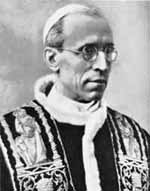
Pope Pius XII
I recently spoke with my cooperating teacher about our class and he was telling me about how the Pope helped the Jews during the Holocaust. He said that Pope Pius XII was writing out forms that indicated Jews as Roman Catholic. I found this interesting so I looked it up. The website below is a synopsis of the work that the Pope did.
It does not say that he forged papers but it says that the Vatican offered to supply part of the money that the Nazis requested after invading Italy. They claimed to take 300 hostages if they money was not paid. The Vatican also hid 477 Jews and 4,238 Jews were protected in Roman minestries and covents.
Pope Pius XII did not publically denounce the Nazi party but did tell members of the church to take in the Jews.
Of course this is only briefly highlights the reading but I encourage everyone to read it. It really demonstrates the silent resistance and in some cases the lack of resistance of the Roman Catholic Church during the Holocaust.
Picture also taken from the above website.
Sunday, April 27, 2008
The Children of Auschwitz
I chose this particular video because it was very moving for me. I am struck by the images of tiny little children being led by their Mother into the gas chamber. I am left without words at knowing they are being led to their deaths. It is like being the proverbial "fly on the wall" where you can see what is happening to someone else while they do not know their own fate.
When I elected to take this Holocaust course at Rhode Island College, I came to it with many questions. I leave the class with even more questions; however, I believe that this is a great thing because we must learn before we can get better. My dream is to become a Lawyer in the very near future. This course has changed my way of thinking in a way I never imagined. I never truly understood what the word justice meant in terms of people. I believe that I do now. I will never allow myself to be a bystander. I will get involve and I will try to make a difference in this world so that events like the Holocaust can never happen again.
I must warn you that when you look at this video you will find it profound. You may even cry like I did when I saw the children. When you view the video, try to image yourself coming off the train. Try to imagine the smells; take in the colors; look closely at the people. If you look close enough you may even see what I saw--that it all looks just like home. The grass is there. The clouds are there. The dirt is even the same color. Even the people are just like you and me.
Racism and discrimination is a cancerous tumor of society that we must excise before we can begin to ever image we can heal. It is possible to get better but it must come from each and every one of us individually. The old saying, the whole outweights the needs of the one should no longer be accepted. It should be the one outweights the needs of the whole. Each individual must count because each one of us makes up the whole.
You will also find the music very moving in this video, and you may also find yourself crying when you see the children. When I see them, all I see is my own children walking towards their death. It is difficult to bear, and unfathomably to totally comprehend.
Polygamy and Discrimination


Polygamy has been making the news recently with the case of the Texas group being removed from their compound. Specifically, where 437 children were taken from their mothers out of the State's concern for child abuse. Just this week, the police have determined that the call from the supposedly 16 year old member of the group was a hoax. Yet, the State of Texas is still choosing to move forward with DNA testing to determine "who the children belong to."
The article referenced below reflects a point of view from someone who chose to join a polygamist group. It is interesting to read this article and hear the words of an individual who has "walked in the shoes" we are all so desperately trying to understand. Discrimination is at the top of the list on this one. I am left pondering many things.
Why are we so intolerant of people when they are "different" from us? Why is it that in order to "fit-in" to society a person must act like the clone of the group? Why is it that society feels the need to break-up groups like the polygamist groups? I believe that the answer lies in the desire to be dominate over the weak--that hegomonic powers fear the minority group when they begin to gain a foothold position in society.
Everyday we are exposed to things that mold our ideologies like the Media, school, newspapers, and other people. All of these exposures become part of our social construction that tells us how we should live. Over and over we are exposed to these elements until we begin to internalize them as part of our own personal beliefs.
It is time for American's to stop being led around like "puppy dogs." It is time that we all do not become "bystanders" any longer. It is time for each and every one of us to get involved for what is right--even if the other person is "not just just like ourselves." We all have a right to be who we are without the fear of persecution by the State or by the People.
As a note, I do not support any action that permits children to be abused; however, I do believe that it is important that we examine things carefully and not fall into the trap of lumping the whole together "just to be safe." No longer should the saying be the needs of the whole outweight the needs of the one. It should be the needs of the one outweight the needs of the whole. Otherwise, we are no better than the Nazi's who persecuted a group of people for the sake of power.
Here's the link to the article:
The photo is part of the following website:

Charlotte Delbo's Auschwitz and After
 Charlotte Delbo’s Auschwitz and After is an emotional and dark autobiographical memoir of a woman and her experiences living though the Holocaust. Working with the French resistance against the German occupation of France, Delbo was caught, arrested, and sent to the concentration camp Auschwitz. Although Delbo was not Jewish, the “Final Solution” was not limited to undesirable ethnic minorities alone. Groups like homosexuals, criminals, the mentally ill, communists, and political prisoners like Delbo, were all targeted by the Nazi secret police – the Gestapo. Using various literary devices like poetry, character sketches, and short stories, Delbo captures the dynamic nature of the Holocaust experience. She paints a vivid portrait of the gruesome and abominable conditions prisoners were forced to endure, while contemporaneously delineating her relationships in the camps. These friendships forged under such terrible conditions, empowered Delbo to endure the death and carnage around her. Transferred to Ravensbruck and eventually freed, the final part of this trilogy explains Delbo’s struggle to acclimate herself to normal life in the wake of history’s most murderous episodes.
The three books presented in Auschwitz and After depict Delbo’s mental and physical state as time progressed. The first book, “None of Us Will Return” is a dramatic and vivid representation of her imprisonment. She discusses the fragile relationship between life and death in the camp, and how the living and working conditions were brutal and dehumanizing. One by one, her friends and acquaintances were executed leaving her to wonder when she would be next. Yet, in midst of all of the morbid and melancholy prose, Delbo outlines those few instances when something positive gave her the will to continue. For example, there is a section where Delbo discusses how thirst was a major problem among the inmates. While on a job, she was about pass out from dehydration. Thanks to her comrades, she procured some water and drank it without being noticed by the SS. If Delbo had collapsed or had been caught, she likely would have been gassed. Delbo finds good, no matter how small it may be, in many instances of her day to day routine in Auschwitz. Each sketch, story, or poem in this section, since it is not organized in any chronological fashion, creates a sense of chaos. It is quite possible that Delbo did this intentionally in an effort to, if in some small way, recreate the chaos of her life at that time.
The second and third books, “Useless Knowledge” and “The Measure of Our Days” respectively, describe Delbo’s transfer to Ravensbruck, her eventual release, and the reconstruction of her life. “Useless Knowledge” refers to the recurring theme of the dread and horror brought forth from living in the camps. These experiences and perspectives forged from living under such harsh conditions, as Delbo insinuates, would not be suitable for the civilized world and are thus “useless.” However, this book begins to show a change in her morale. Leaving Auschwitz for the work camp Ravensbruck meant survival for her and her comrades. For once, there was a glimmer of hope. Shortly after their arrival, rumors of liberation spread throughout the camp. When one of her roommates in the barracks became deathly ill, she asked when they would gain their freedom. Since Delbo’s life revolved around the twenty-third of various months (met her husband, husband’s execution, and arrival at Auschwitz), she told the woman that they would be freed on April 23rd. Surprisingly, this prophecy came true and the women were released to the Swedish Red Cross.
While most Holocaust memoirs tend to stop at the liberation of the camps, Delbo indicates that her struggle did not end at the gates of Ravensbruck. She struggled to readjust and fit into the post-Holocaust world. Additionally, one of the major themes of Auschwitz and After is memory – how does one remember the myriad of complex and gruesome experiences? Does one want to recall? How does one discuss these details with others? In describing the lives of her fellow survivors suffering from posttraumatic stress disorder, she paints the picture of her own life and how it was enormously difficult to adjust to normal life. One of the most heart-wrenching examples of this is the survivor guilt experienced by Delbo and her comrades. Their lives were so bad in the camps, that they could not fathom how they could still be alive. Delbo writes that there were many others that were so much stronger than she, who were pointlessly murdered. The emotional rollercoaster of being imprisoned amongst death and dying to being freed was tortuous in itself. Their situation was not freedom, for they were still prisoners of their memories.
In summary, Charlotte Delbo’s Auschwitz and After is a vividly somber look at the Holocaust and its negative everlasting effects on the survivors. Using poetry, short stories, and character sketches, Delbo presents a rich and dynamic narrative on the complexities of one of history’s most horrific periods. Using her friendships forged in the living Hell in order to survive, Delbo outlined the few good moments during her stay in Auschwitz and Ravensbruck as pillars of hope in an otherwise hopeless environment. While Delbo wondered how best to depict the atrocities of the Holocaust, she has apparently done so with Auschwitz and After as both an history and a literary masterpiece.
Cover Photo: http://en.wikipedia.org/wiki/Image:Auschwitz_and_After_cover.jpg

(This is a copy of a precis I wrote last semester for Dr. Joanne Schneider's WMST 350 "Women's Autobiographies and Memoirs Since 1870." Reproduction is prohibited without consent.)
Fire damage at Sachsenhausen Concentration Camp
Sachsenhausen concentration camp is located in Oranienburg, 45 minutes outside of Berlin, and was the first of its kind in Germany. It was established in 1938, and primarily used for political prisoners, though medical experiments occurred there as well. Estimates place the number of victims at over 30,000.

This picture is from the inside of one of the barracks, taken during my trip to Germany in March. In 1992, neo-Nazis set fire to this building and one other shortly after the then-Prime Minister of Israel visited the camp. The directors of the site chose not to repair the damage, and thus leave a reminder that this type of hatred is still strong today. Five years after the arson, the camp was reopened as a memorial.
During my visit to the camp, there were many chilling moments, and I certainly can't say that this was the most chilling (that label is reserved for Station Z and the morgue). However, it was certainly shocking and upsetting to realize that within the last twenty years, it has been shown that the hatred of the Holocaust is still strong.
When I was researching to determine the date of this particular event, I found several sites listing reports of anti-Semetic incidents. Within the last month, an Adolf Hitler doll has been manufactured in the Ukraine, a Jewish cemetary in Germany was vandalized, a synagogue in Miami Beach was set ablaze, and vandals painted swastikas and graffiti on a Holocaust memorial in Belarus, among other events. It is more clear to me now than ever that the atrocities of the Holocaust are not strictly locked in the past, but are still with us today.
For information about anti-Semetic incidents since October 1, 2001, see The Coordination Forum for Countering Antisemitism's website at http://www.antisemitism.org.il/.
Prior to that date, information is available at the Israel Ministry of Foreign Affairs' Antisemitism Monitoring Forum, at http://www.mfa.gov.il/MFA/Anti-Semitism+and+the+Holocaust/Antisemitism+Monitoring+Forum/.
The Holocaust and Neo-Fascism: Art as Resistance in the Contemporary Gay Community
During my research for this assignment, I stumbled across this YouTube video by thepinkpasty. It is a video slide show of the brutality homosexuals had to endure in the various concentration camps of the Nazi regime. But this work also goes a step further. The video sends a clear message that groups who are sympathetic to the Nazi ideology still exist today.
The author links those radical groups to the Catholic church because of its longstanding disapproval of same sex relationships. The work specifically targets Pope Benedict XVI and charges that he willfully enrolled in Hitler's Youth as a teenager. While most of the factual information of the video is historically accurate, Ratzinger did not join Hitler's Youth of his own accord - enrollment was compulsory. Additionally, Ratzinger's father was an ardent opponent of Nazi policies.
The author cautions that "the bitch that bore that dog of war... is still in heat," a stern warning that Nazi sentiment is still out there and ready to once again take hold.
Saturday, April 26, 2008
Pierre Seel: A Defiant Shade of Pink
 Much like the Roma, homosexual victims and survivors of the German Holocaust have been, until recently, a mere footnote of the historical record. Not in any way diminishing the nearly six million Jews who perished at the hands of the Nazi regime, homosexuals also fell victim to Hitler's twisted desires for the creation of a Master Race. These men, branded with a pink triangle, were relegated to the lowest rung of the concentration camp's social strata. Often beaten, raped, and openly mocked, these prisoners faced terrible physical and psychological odds.
What is so interesting about the governmental persecution of homosexuals in Nazi controlled Europe is that there is not much precedent for it. Germany, and to a greater extent France, was historically very tolerant of homosexuality. In fact, homosexuality was legal in France up until 1940 when the German controlled Vichy government outlawed it. This crackdown stemed from a newly revised section of the penal code known as Paragraph 175, which facilitated apprehension and prosecution of those men who harbor gay tendencies. This eventually spread to all areas occupied by Nazi Germany.
Behind this backdrop we meet Pierre Seel, a young eighteen year old gay man. Because he had reported to the police that his watch was stolen at a popular homosexual gathering area, he was arrested by the Gestapo on May 1, 1941. After being tortured for ten days, he was send to Schirmeck-Vorbruck, the only German concentration camp on French soil. While there he was "tortured, beaten, sodomized and raped" and was forced to build the gigantic furnaces used to cremate the murdered. After six months he was released and forced to join the Nazi army. After the war he settled down, and never spoke a word of his tribulations to anyone. He married and had three children, but later divorced.
Pierre Seel wrote or contributed to several works including Liberation Was for Others: Memoirs of a Gay Survivor of the Nazi Holocaust (April 1997), and Moi, Pierre Seel, déporté homosexuel (1994) as pictured above. Seel was interviewed by Rob Epstein for his 2000 documentary film Paragraph 175, highlighting the Nazi campaign against homosexuals. Seel died on November 25, 2005.
There are very few (less than ten) gay Holocaust survivors still alive today.
Information and References:
National Public Radio remembers Pierre Seel:
http://www.npr.org/templates/story/story.php?storyId=5036618
United States Holocaust Memorial Museum:
http://www.ushmm.org/museum/exhibit/online/hsx/
The Washington Post - "Pierre Seel Dies; Bore Witness to Nazi Torture of Gays."
http://www.washingtonpost.com/wp-dyn/content/article/2005/12/01/AR2005120101637.html
Wikipedia - Pierre Seel:
http://en.wikipedia.org/wiki/Pierre_Seel
Friday, April 25, 2008
Darfur Genocide: A Student Slideshow
I chose this video, created by RagingxLunaticx3 on Youtube, because it embodies the power of student voice in response to the Darfur Holocaust. In Darfur, located in western Sudan, the Sudanese government forces and militia called “Janjaweed” have been engaged in an armed conflict with rebel groups called the Sudanese Liberation Army/Movement (SLA/SLM) and the Justice and Equality Movement (JEM). As part of its operations against the rebels, government forces waged a systematic campaign of “ethnic cleansing” against civilians who are members of the same ethnic groups as the rebels. Sudanese government forces and the Janjaweed militias burned and destroyed hundreds of villages, caused tens of thousands of civilian deaths, displaced millions of people, and raped and assaulted thousands of women and girls.
What is happening in Darfur is not unlike the Jewish Holocaust. As of April 2008, some 2.5 million displaced people live in camps in Darfur and more than 200,000 people have fled to neighboring Chad, where they live in refugee camps. In addition to the people displaced by the conflict, at least 2 million additional people are considered “conflict-affected” by the United Nations (UN) and many need some form of food assistance because the conflict has damaged the local economy, markets, and trade in Darfur. The number one cause of death is starvation.
This video, choosing to depict hope and resilience, is trying to convey that we (students) and everyone with a voice can help put an end to this genocide. Whatever happened to never again? The Sudanese government admits to less then 10,000 deaths. More accurate estimates range from 200,000-400,000 in the five years of conflict. They are trying to hide what evidence suggests they are responsible for, much like Hitler tried to mask the horror in Terezin.
Information sourced by: http://www.hrw.org/english/docs/2004/05/05/darfur8536.htm
Thursday, April 24, 2008
Abord the Underground Railroad
I believe the underground railroad is a perfect example of resistance and defiance during the slavery era, in the 1840's. The most important factor of the underground railroad was that "it consistently exposed the grim realities of slavery and more importantly, refuted the claim that African Americans could not act or organize on their own." "The secondary importance was it provided an opportunity for sympathetic white Americans to play a role in resisting slavery." The harsh punishments given to runaway slaves made this a deadly form of resistance. The treatment of slaves must have been unbearable because thousands of slaves risked their lives traveling through the underground railroad, resisting their owner's harsh treatment, with a hope of reaching freedom. This article is a good read, not too long. Full of facts; some I did not know. For example, did you know the underground railroad helped rescue arrested fugitives in the north?
http://www.nps.gov/nr/travel/underground/ugrrintr.htm
http://www.nps.gov/nr/travel/underground/ugrrintr.htm
This column poses the question that we have been discussing all semester. Was the Ukranian famine of the late 1940's a holocaust as we understand the meaning of the term? David Mittell is a projo columnist that frequently writes about the Ukraine and its tortured history. This piece (which was in the paper yesterday) explores the question posed above. Our class rightly paints Adolf Hitler as a mass murderer of millions, but his Soviet counterpart Josef Stalin is known to have killed millions more and oversaw cruelty the likes of which the world had never seen. His atrocities were largely hidden because he was a wartime ally of the U.S., and because Soviet Russia was an incredibly secretive society. I will post part two of this article when published.
David A. Mittell Jr.: Genocide? You decide | Columnists | Rhode Island news | projo.com | The Providence Journal | Breaking news
David A. Mittell Jr.: Genocide? You decide | Columnists | Rhode Island news | projo.com | The Providence Journal | Breaking news
Tuesday, April 22, 2008
Weapons of the Spirit
Here's the video Weapons of the Spirit that is about the French Village of Le Chambon. More information can be found at the Chambon Foundation.
Memorial at Terezin

Memorial at Terezin - sculpted by Helga Weissova, whose drawings (as a child) we looked at in class. This memorial is placed at the train station at Terezin.
Orgins of the Torch Relay
As w e watch China act and react to the protests surrounding the Olympic Torch relay, it's time to take a look at history. This short article from The New York Times describes the origins of the Olympic Torch relay ...
Somehow in the popular imagination, the relay began in ancient Greece or more realistically perhaps with rebirth of the Modern Olympic Games in 1896.
No, the torch relay began in Berlin - in 1936 - for the opening of Leni Riefenstahl’s film, “Olympia.” According to the article, the relay, held as tradition, began as a symbolic passing of the torch from Ancient Greece to Nazi Germany.
Imagine - the Olympic Torch being used as propaganda ... my how the world has changed???
e watch China act and react to the protests surrounding the Olympic Torch relay, it's time to take a look at history. This short article from The New York Times describes the origins of the Olympic Torch relay ...Somehow in the popular imagination, the relay began in ancient Greece or more realistically perhaps with rebirth of the Modern Olympic Games in 1896.
No, the torch relay began in Berlin - in 1936 - for the opening of Leni Riefenstahl’s film, “Olympia.” According to the article, the relay, held as tradition, began as a symbolic passing of the torch from Ancient Greece to Nazi Germany.
Imagine - the Olympic Torch being used as propaganda ... my how the world has changed???
Subscribe to:
Posts (Atom)