Wednesday, April 30, 2008

Hermann Graebe - Resistance After the Fact?

In my Western History class this semester, I wrote a short essay and gave a presentation on Hermann Graebe.


A German construction engineer, he was a former Nazi who left the party and rescued Jewish citizens during the war. At a site of mass killings in Dubno, Ukraine, Graebe and his construction foreman witnessed the SS instructing Jews to line up and remove their clothing, after which they were shot. Other Jews were told to move the bodies of their family members into the pit and then climb in themselves, also to be shot. After the war, Graebe was the only German citizen who volunteered to testify at the Nuremberg Trials. Because of his testimony, Graebe was outcast and moved his family to San Francisco in 1948, where he died in 1986 at age 85.


This is a link to a site from Fordham University - Graebe's declaration under oath can be found here.


Do you feel that Graebe's testimony was a form of resistance, even though it came after the Holocaust? By renouncing the Nazi party and helping the Jews during the war, it seems like he did what he could at the time, rather than being just another bystander. He was honored as a "Righteous Among the Nations" by the Israelis, meaning that he was a non-Jewish person who risked his life to rescue or assist Jewish people during the war.

Tuesday, April 29, 2008

Never Again...

There are two videos that I want to post; both from YouTube. The first is entitles Current Genocides-Never Again???!!! In three and a half minutes it captures the idea that the world is not changing. That there are still geocides going on after everyone said that they would not let something like The Holocaust happen again. The movie looks at Rwanda in 1994, Bosnia 1995, Darfur 2003 and Kenya 2008. The Holocaust ended over 50 years ago and yet the pictures dipicted within the video resemble those that suffered so many years ago.

The women who created the video, raquelita120, made it for a presentation for public schools by her college. I posted this because so many look and say what can I do? Rwanda, Bosnia, Darfur, and Kenya are so far away how can I help those suffering and being murdered. This women, along with her classmates did what they could to help. They made this informational video to educate our youth to be active against this abuse. Her resistance is to not be silent and not let these issues continue to go unnoticed.


The movies are both very graphic so take caution when viewing.


The second video is entitled, Never Again, Darfur. This video shows pictures from the Holocaust and then pictures from Darfur. It is eerie to see the resemblance between the two. The creator, AlexKress, states,

I'm often asked why help Darfur? What benefit does it bring us? This is the attitude that killed 11 Million during the Nazi Regime in Europe. We promised Never Again, then Rwanda happened and once again we promised Never Again. Yet here we are, with another genocide occurring on our watch.

I think this is amazing. She is educating anyone who will watch about the horrendous conditions around the world. The beginning of the film implies that that we don't help because we are not being targeted. The text reads, "First they came for the socialists, and I did not speak out because I was not a socialist." Next, they came for the Trade Unionists and then the Jews. It is written that we did not speak out because they were not like us, but then they came for us but nobody was there to speak out. She is making the video personal but saying yes this is not you right now but who is going to speak out for you when you are targeted? Never Again? Can that really be true? Can we all voice our outrage to help to prevent genocides around the world?

Catholic Church


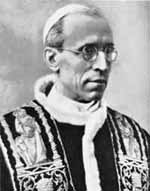
Pope Pius XII
I recently spoke with my cooperating teacher about our class and he was telling me about how the Pope helped the Jews during the Holocaust. He said that Pope Pius XII was writing out forms that indicated Jews as Roman Catholic. I found this interesting so I looked it up. The website below is a synopsis of the work that the Pope did.

It does not say that he forged papers but it says that the Vatican offered to supply part of the money that the Nazis requested after invading Italy. They claimed to take 300 hostages if they money was not paid. The Vatican also hid 477 Jews and 4,238 Jews were protected in Roman minestries and covents.

Pope Pius XII did not publically denounce the Nazi party but did tell members of the church to take in the Jews.

Of course this is only briefly highlights the reading but I encourage everyone to read it. It really demonstrates the silent resistance and in some cases the lack of resistance of the Roman Catholic Church during the Holocaust.
Picture also taken from the above website.

Sunday, April 27, 2008

The Children of Auschwitz


I chose this particular video because it was very moving for me. I am struck by the images of tiny little children being led by their Mother into the gas chamber. I am left without words at knowing they are being led to their deaths. It is like being the proverbial "fly on the wall" where you can see what is happening to someone else while they do not know their own fate.

When I elected to take this Holocaust course at Rhode Island College, I came to it with many questions. I leave the class with even more questions; however, I believe that this is a great thing because we must learn before we can get better. My dream is to become a Lawyer in the very near future. This course has changed my way of thinking in a way I never imagined. I never truly understood what the word justice meant in terms of people. I believe that I do now. I will never allow myself to be a bystander. I will get involve and I will try to make a difference in this world so that events like the Holocaust can never happen again.

I must warn you that when you look at this video you will find it profound. You may even cry like I did when I saw the children. When you view the video, try to image yourself coming off the train. Try to imagine the smells; take in the colors; look closely at the people. If you look close enough you may even see what I saw--that it all looks just like home. The grass is there. The clouds are there. The dirt is even the same color. Even the people are just like you and me.

Racism and discrimination is a cancerous tumor of society that we must excise before we can begin to ever image we can heal. It is possible to get better but it must come from each and every one of us individually. The old saying, the whole outweights the needs of the one should no longer be accepted. It should be the one outweights the needs of the whole. Each individual must count because each one of us makes up the whole.

You will also find the music very moving in this video, and you may also find yourself crying when you see the children. When I see them, all I see is my own children walking towards their death. It is difficult to bear, and unfathomably to totally comprehend.

Polygamy and Discrimination


Polygamy has been making the news recently with the case of the Texas group being removed from their compound. Specifically, where 437 children were taken from their mothers out of the State's concern for child abuse. Just this week, the police have determined that the call from the supposedly 16 year old member of the group was a hoax. Yet, the State of Texas is still choosing to move forward with DNA testing to determine "who the children belong to."
The article referenced below reflects a point of view from someone who chose to join a polygamist group. It is interesting to read this article and hear the words of an individual who has "walked in the shoes" we are all so desperately trying to understand. Discrimination is at the top of the list on this one. I am left pondering many things.

Why are we so intolerant of people when they are "different" from us? Why is it that in order to "fit-in" to society a person must act like the clone of the group? Why is it that society feels the need to break-up groups like the polygamist groups? I believe that the answer lies in the desire to be dominate over the weak--that hegomonic powers fear the minority group when they begin to gain a foothold position in society.
Everyday we are exposed to things that mold our ideologies like the Media, school, newspapers, and other people. All of these exposures become part of our social construction that tells us how we should live. Over and over we are exposed to these elements until we begin to internalize them as part of our own personal beliefs.
It is time for American's to stop being led around like "puppy dogs." It is time that we all do not become "bystanders" any longer. It is time for each and every one of us to get involved for what is right--even if the other person is "not just just like ourselves." We all have a right to be who we are without the fear of persecution by the State or by the People.

As a note, I do not support any action that permits children to be abused; however, I do believe that it is important that we examine things carefully and not fall into the trap of lumping the whole together "just to be safe." No longer should the saying be the needs of the whole outweight the needs of the one. It should be the needs of the one outweight the needs of the whole. Otherwise, we are no better than the Nazi's who persecuted a group of people for the sake of power.
Here's the link to the article:
The photo is part of the following website:

Charlotte Delbo's Auschwitz and After

Charlotte Delbo’s Auschwitz and After is an emotional and dark autobiographical memoir of a woman and her experiences living though the Holocaust. Working with the French resistance against the German occupation of France, Delbo was caught, arrested, and sent to the concentration camp Auschwitz. Although Delbo was not Jewish, the “Final Solution” was not limited to undesirable ethnic minorities alone. Groups like homosexuals, criminals, the mentally ill, communists, and political prisoners like Delbo, were all targeted by the Nazi secret police – the Gestapo. Using various literary devices like poetry, character sketches, and short stories, Delbo captures the dynamic nature of the Holocaust experience. She paints a vivid portrait of the gruesome and abominable conditions prisoners were forced to endure, while contemporaneously delineating her relationships in the camps. These friendships forged under such terrible conditions, empowered Delbo to endure the death and carnage around her. Transferred to Ravensbruck and eventually freed, the final part of this trilogy explains Delbo’s struggle to acclimate herself to normal life in the wake of history’s most murderous episodes.

The three books presented in Auschwitz and After depict Delbo’s mental and physical state as time progressed. The first book, “None of Us Will Return” is a dramatic and vivid representation of her imprisonment. She discusses the fragile relationship between life and death in the camp, and how the living and working conditions were brutal and dehumanizing. One by one, her friends and acquaintances were executed leaving her to wonder when she would be next. Yet, in midst of all of the morbid and melancholy prose, Delbo outlines those few instances when something positive gave her the will to continue. For example, there is a section where Delbo discusses how thirst was a major problem among the inmates. While on a job, she was about pass out from dehydration. Thanks to her comrades, she procured some water and drank it without being noticed by the SS. If Delbo had collapsed or had been caught, she likely would have been gassed. Delbo finds good, no matter how small it may be, in many instances of her day to day routine in Auschwitz. Each sketch, story, or poem in this section, since it is not organized in any chronological fashion, creates a sense of chaos. It is quite possible that Delbo did this intentionally in an effort to, if in some small way, recreate the chaos of her life at that time.

The second and third books, “Useless Knowledge” and “The Measure of Our Days” respectively, describe Delbo’s transfer to Ravensbruck, her eventual release, and the reconstruction of her life. “Useless Knowledge” refers to the recurring theme of the dread and horror brought forth from living in the camps. These experiences and perspectives forged from living under such harsh conditions, as Delbo insinuates, would not be suitable for the civilized world and are thus “useless.” However, this book begins to show a change in her morale. Leaving Auschwitz for the work camp Ravensbruck meant survival for her and her comrades. For once, there was a glimmer of hope. Shortly after their arrival, rumors of liberation spread throughout the camp. When one of her roommates in the barracks became deathly ill, she asked when they would gain their freedom. Since Delbo’s life revolved around the twenty-third of various months (met her husband, husband’s execution, and arrival at Auschwitz), she told the woman that they would be freed on April 23rd. Surprisingly, this prophecy came true and the women were released to the Swedish Red Cross.

While most Holocaust memoirs tend to stop at the liberation of the camps, Delbo indicates that her struggle did not end at the gates of Ravensbruck. She struggled to readjust and fit into the post-Holocaust world. Additionally, one of the major themes of Auschwitz and After is memory – how does one remember the myriad of complex and gruesome experiences? Does one want to recall? How does one discuss these details with others? In describing the lives of her fellow survivors suffering from posttraumatic stress disorder, she paints the picture of her own life and how it was enormously difficult to adjust to normal life. One of the most heart-wrenching examples of this is the survivor guilt experienced by Delbo and her comrades. Their lives were so bad in the camps, that they could not fathom how they could still be alive. Delbo writes that there were many others that were so much stronger than she, who were pointlessly murdered. The emotional rollercoaster of being imprisoned amongst death and dying to being freed was tortuous in itself. Their situation was not freedom, for they were still prisoners of their memories.

In summary, Charlotte Delbo’s Auschwitz and After is a vividly somber look at the Holocaust and its negative everlasting effects on the survivors. Using poetry, short stories, and character sketches, Delbo presents a rich and dynamic narrative on the complexities of one of history’s most horrific periods. Using her friendships forged in the living Hell in order to survive, Delbo outlined the few good moments during her stay in Auschwitz and Ravensbruck as pillars of hope in an otherwise hopeless environment. While Delbo wondered how best to depict the atrocities of the Holocaust, she has apparently done so with Auschwitz and After as both an history and a literary masterpiece.

Cover Photo: http://en.wikipedia.org/wiki/Image:Auschwitz_and_After_cover.jpg

(This is a copy of a precis I wrote last semester for Dr. Joanne Schneider's WMST 350 "Women's Autobiographies and Memoirs Since 1870." Reproduction is prohibited without consent.)

Fire damage at Sachsenhausen Concentration Camp

Sachsenhausen concentration camp is located in Oranienburg, 45 minutes outside of Berlin, and was the first of its kind in Germany. It was established in 1938, and primarily used for political prisoners, though medical experiments occurred there as well. Estimates place the number of victims at over 30,000.


This picture is from the inside of one of the barracks, taken during my trip to Germany in March. In 1992, neo-Nazis set fire to this building and one other shortly after the then-Prime Minister of Israel visited the camp. The directors of the site chose not to repair the damage, and thus leave a reminder that this type of hatred is still strong today. Five years after the arson, the camp was reopened as a memorial.
During my visit to the camp, there were many chilling moments, and I certainly can't say that this was the most chilling (that label is reserved for Station Z and the morgue). However, it was certainly shocking and upsetting to realize that within the last twenty years, it has been shown that the hatred of the Holocaust is still strong.
When I was researching to determine the date of this particular event, I found several sites listing reports of anti-Semetic incidents. Within the last month, an Adolf Hitler doll has been manufactured in the Ukraine, a Jewish cemetary in Germany was vandalized, a synagogue in Miami Beach was set ablaze, and vandals painted swastikas and graffiti on a Holocaust memorial in Belarus, among other events. It is more clear to me now than ever that the atrocities of the Holocaust are not strictly locked in the past, but are still with us today.
For information about anti-Semetic incidents since October 1, 2001, see The Coordination Forum for Countering Antisemitism's website at http://www.antisemitism.org.il/.
Prior to that date, information is available at the Israel Ministry of Foreign Affairs' Antisemitism Monitoring Forum, at http://www.mfa.gov.il/MFA/Anti-Semitism+and+the+Holocaust/Antisemitism+Monitoring+Forum/.

The Holocaust and Neo-Fascism: Art as Resistance in the Contemporary Gay Community


During my research for this assignment, I stumbled across this YouTube video by thepinkpasty. It is a video slide show of the brutality homosexuals had to endure in the various concentration camps of the Nazi regime. But this work also goes a step further. The video sends a clear message that groups who are sympathetic to the Nazi ideology still exist today.

The author links those radical groups to the Catholic church because of its longstanding disapproval of same sex relationships. The work specifically targets Pope Benedict XVI and charges that he willfully enrolled in Hitler's Youth as a teenager. While most of the factual information of the video is historically accurate, Ratzinger did not join Hitler's Youth of his own accord - enrollment was compulsory. Additionally, Ratzinger's father was an ardent opponent of Nazi policies.

The author cautions that "the bitch that bore that dog of war... is still in heat," a stern warning that Nazi sentiment is still out there and ready to once again take hold.

Saturday, April 26, 2008

Pierre Seel: A Defiant Shade of Pink

Much like the Roma, homosexual victims and survivors of the German Holocaust have been, until recently, a mere footnote of the historical record. Not in any way diminishing the nearly six million Jews who perished at the hands of the Nazi regime, homosexuals also fell victim to Hitler's twisted desires for the creation of a Master Race. These men, branded with a pink triangle, were relegated to the lowest rung of the concentration camp's social strata. Often beaten, raped, and openly mocked, these prisoners faced terrible physical and psychological odds.

What is so interesting about the governmental persecution of homosexuals in Nazi controlled Europe is that there is not much precedent for it. Germany, and to a greater extent France, was historically very tolerant of homosexuality. In fact, homosexuality was legal in France up until 1940 when the German controlled Vichy government outlawed it. This crackdown stemed from a newly revised section of the penal code known as Paragraph 175, which facilitated apprehension and prosecution of those men who harbor gay tendencies. This eventually spread to all areas occupied by Nazi Germany.

Behind this backdrop we meet Pierre Seel, a young eighteen year old gay man. Because he had reported to the police that his watch was stolen at a popular homosexual gathering area, he was arrested by the Gestapo on May 1, 1941. After being tortured for ten days, he was send to Schirmeck-Vorbruck, the only German concentration camp on French soil. While there he was "tortured, beaten, sodomized and raped" and was forced to build the gigantic furnaces used to cremate the murdered. After six months he was released and forced to join the Nazi army. After the war he settled down, and never spoke a word of his tribulations to anyone. He married and had three children, but later divorced.

Pierre Seel wrote or contributed to several works including Liberation Was for Others: Memoirs of a Gay Survivor of the Nazi Holocaust (April 1997), and Moi, Pierre Seel, déporté homosexuel (1994) as pictured above. Seel was interviewed by Rob Epstein for his 2000 documentary film Paragraph 175, highlighting the Nazi campaign against homosexuals. Seel died on November 25, 2005.

There are very few (less than ten) gay Holocaust survivors still alive today.

Information and References:

National Public Radio remembers Pierre Seel:
http://www.npr.org/templates/story/story.php?storyId=5036618

United States Holocaust Memorial Museum:
http://www.ushmm.org/museum/exhibit/online/hsx/

The Washington Post - "Pierre Seel Dies; Bore Witness to Nazi Torture of Gays."
http://www.washingtonpost.com/wp-dyn/content/article/2005/12/01/AR2005120101637.html

Wikipedia - Pierre Seel:
http://en.wikipedia.org/wiki/Pierre_Seel

Friday, April 25, 2008

Darfur Genocide: A Student Slideshow


I chose this video, created by RagingxLunaticx3 on Youtube, because it embodies the power of student voice in response to the Darfur Holocaust. In Darfur, located in western Sudan, the Sudanese government forces and militia called “Janjaweed” have been engaged in an armed conflict with rebel groups called the Sudanese Liberation Army/Movement (SLA/SLM) and the Justice and Equality Movement (JEM). As part of its operations against the rebels, government forces waged a systematic campaign of “ethnic cleansing” against civilians who are members of the same ethnic groups as the rebels. Sudanese government forces and the Janjaweed militias burned and destroyed hundreds of villages, caused tens of thousands of civilian deaths, displaced millions of people, and raped and assaulted thousands of women and girls.

What is happening in Darfur is not unlike the Jewish Holocaust. As of April 2008, some 2.5 million displaced people live in camps in Darfur and more than 200,000 people have fled to neighboring Chad, where they live in refugee camps. In addition to the people displaced by the conflict, at least 2 million additional people are considered “conflict-affected” by the United Nations (UN) and many need some form of food assistance because the conflict has damaged the local economy, markets, and trade in Darfur. The number one cause of death is starvation.

This video, choosing to depict hope and resilience, is trying to convey that we (students) and everyone with a voice can help put an end to this genocide. Whatever happened to never again? The Sudanese government admits to less then 10,000 deaths. More accurate estimates range from 200,000-400,000 in the five years of conflict. They are trying to hide what evidence suggests they are responsible for, much like Hitler tried to mask the horror in Terezin.

Information sourced by: http://www.hrw.org/english/docs/2004/05/05/darfur8536.htm

Thursday, April 24, 2008

Abord the Underground Railroad

I believe the underground railroad is a perfect example of resistance and defiance during the slavery era, in the 1840's. The most important factor of the underground railroad was that "it consistently exposed the grim realities of slavery and more importantly, refuted the claim that African Americans could not act or organize on their own." "The secondary importance was it provided an opportunity for sympathetic white Americans to play a role in resisting slavery." The harsh punishments given to runaway slaves made this a deadly form of resistance. The treatment of slaves must have been unbearable because thousands of slaves risked their lives traveling through the underground railroad, resisting their owner's harsh treatment, with a hope of reaching freedom. This article is a good read, not too long. Full of facts; some I did not know. For example, did you know the underground railroad helped rescue arrested fugitives in the north?
http://www.nps.gov/nr/travel/underground/ugrrintr.htm
This column poses the question that we have been discussing all semester. Was the Ukranian famine of the late 1940's a holocaust as we understand the meaning of the term? David Mittell is a projo columnist that frequently writes about the Ukraine and its tortured history. This piece (which was in the paper yesterday) explores the question posed above. Our class rightly paints Adolf Hitler as a mass murderer of millions, but his Soviet counterpart Josef Stalin is known to have killed millions more and oversaw cruelty the likes of which the world had never seen. His atrocities were largely hidden because he was a wartime ally of the U.S., and because Soviet Russia was an incredibly secretive society. I will post part two of this article when published.
David A. Mittell Jr.: Genocide? You decide | Columnists | Rhode Island news | projo.com | The Providence Journal | Breaking news

Hopes for Roma TV

Tuesday, April 22, 2008

Weapons of the Spirit


Here's the video Weapons of the Spirit that is about the French Village of Le Chambon. More information can be found at the Chambon Foundation.

Memorial at Terezin


Memorial at Terezin - sculpted by Helga Weissova, whose drawings (as a child) we looked at in class. This memorial is placed at the train station at Terezin.

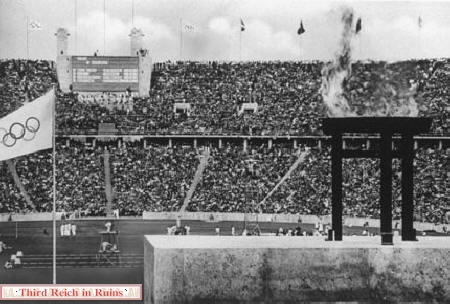
Orgins of the Torch Relay

As we watch China act and react to the protests surrounding the Olympic Torch relay, it's time to take a look at history. This short article from The New York Times describes the origins of the Olympic Torch relay ...

Somehow in the popular imagination, the relay began in ancient Greece or more realistically perhaps with rebirth of the Modern Olympic Games in 1896.

No, the torch relay began in Berlin - in 1936 - for the opening of Leni Riefenstahl’s film, “Olympia.” According to the article, the relay, held as tradition, began as a symbolic passing of the torch from Ancient Greece to Nazi Germany.

Imagine - the Olympic Torch being used as propaganda ... my how the world has changed???